Since leaving Bolivia in August of 2012 and getting married in November, updated the blog has fallen by the wayside. However, Lisa and I have a new blog which can be found at the following address!
www.dlspeyers.blogspot.com
Friday, February 15, 2013

Sunday, July 8, 2012
Character
When I was studying aviation in college, I had a flight instructor who talk a lot about character. He said that what made a good pilot was not necessarily the ability to fly the airplane. Sure, you need the hands-on skills, but what you really needed was character. The kind of character that knows your own physical limits, the limits of the airplane, and the limits put over you by regulations or operation manuals. On a recent flight, I had my own character tested, in all of the previously mentioned ways.

An early takeoff was planned from Santa Cruz and I would be bringing four passengers to a remote community over 300 miles way. There was extra baggage, some clothing that would be given away to needy people during a 10 day river boat trip, but we were at our legal weight limit for the airplane with only the four passengers and their baggage. As much as the clothing was needed, I was not going to exceed the gross weight of the airplane even though it would have been for a very good cause. This is sometimes the hard part about mission flying, there are so many needs and as a missionary you want to help everybody. However compromising safety would be just that, compromising.

After a three hour flight against strong head winds, I dropped off the four passengers and flew one hour to a nearby town to refuel and pick up three more passengers. Since this was a controlled airport, time on the ground took over an hour due to the need for filling out flight plans, receiving a weather briefing, filling out a passenger manifest, and having the "Anti-Drug" authorities look through all the baggage. On the one hour flight back to the community where the river boat was based, I began to calculate how much time I could stay on the ground before needing to leave for Santa Cruz and make it back before sunset. In Bolivia, single engine airplanes are not allowed to fly at night time, so all flights must be on the ground before sunset. Our personal SAMAIR manual says that we need to be on the ground an hour before sunset unless there is good weather at the destination and we have permission from the chief pilot. I calculated that 20 minutes on the ground would give me a 15 minutes cushion if we wanted to get back before sunset. Upon landing, I told the passenger he had 20 minutes, not a minute more.

Unfortunately he took 35 minutes. Sunset was at 5:46pm and I knew it would take two hours to get back home, even with the tailwind helping us. Level at our cruising altitude, the GPS was saying our arrival would be at 5:46. Running the engine at a higher power setting than normal and staying at a lower altitude to take advantage of the winds, I watch as the GPS flickered between 5:45 and 5:47 for the next hour. It had been a long day and the thought of spending the night in my own bed was mighty draw. However I knew that the GPS was giving me an arrival time which did not include two minutes of circling over the landing field to land. 40 minutes out the GPS was holding steady on 5:46pm. My mind began trying to rationalize landing two minutes after sunset.
Since I am the only pilot with SAM in Bolivia, I am the chief pilot, I can do what I want! The mechanics have no idea when its sunset, it will still be light out and they wont know the difference of two minutes anyways. I'm physically tired from flying 6 hours! Its just two minutes...

Then the words of my flight instructor came back to me. One of his favorite quotes began running through my mind:
Character cannot be summoned at the moment of crisis if it has been squandered by years of compromise and rationalization. The only testing ground for the heroic is the mundane. The only preparation for that one profound decision which can change a life, or even a nation, is those hundreds of half-conscious, self-defining, seemingly insignificant decisions made in private. Habit is the daily battleground of character.
-Senator Dan Coats
I knew I would be compromising my character if I continued on. I knew I would would be rationalizing my decision to continue on. So, 40 minutes from home base, I turned the airplane 30 degrees to the left, got on the radio to home base, and informed them that I was not going to be able to make it home before sunset. I would be landing at an airport in ten minutes and spending the night there. Two minutes is not very much time, but for me, it was enough to remind me what character was really all about.

Sunday, June 17, 2012
Belt failure
Last week I had another electrical system failure. Previously I had a ring terminal break which connected the alternator output to the main aircraft power bus. So this time when I saw the red and amber warning lights come on while flying I assumed that another ring terminal had broken.

After landing I took the cowling off and found that the alternator belt had broken. Thankfully by minimizing all the electrical loads I was able to make it two hours back to home base where we installed a new belt.

Mr. President
On a recent trip to northern Bolivia, I was informed that the President of Bolivia would be visiting the same city as my destination! In the USA, whenever the president travels there is always a large TFR (Temporary Flight Restriction) and no other airplane are allowed in the airspace. Before leaving on my flight I checked to see if the airport was still open and they said YES. Upon arriving, the President of Bolivia showed up within 5 minutes and I was able to walk right up take a few pictures! Definetly a once in a life time experience for me!

In case your wondering, his ride for the day was a Kingair 90. About a $300,000 airplane. Airforce One cost $400 million.

On the return trip, I brought three eye doctors back to Santa Cruz who had been doing surgeries for people in this remote area of Bolivia. All of their work and time was donated and they accomplished over 30 surgeries in two weeks time. My co-pilot for the day was very interested in aviation so I gave him the change to fly the airplane. Everybody else took a two hour nap.


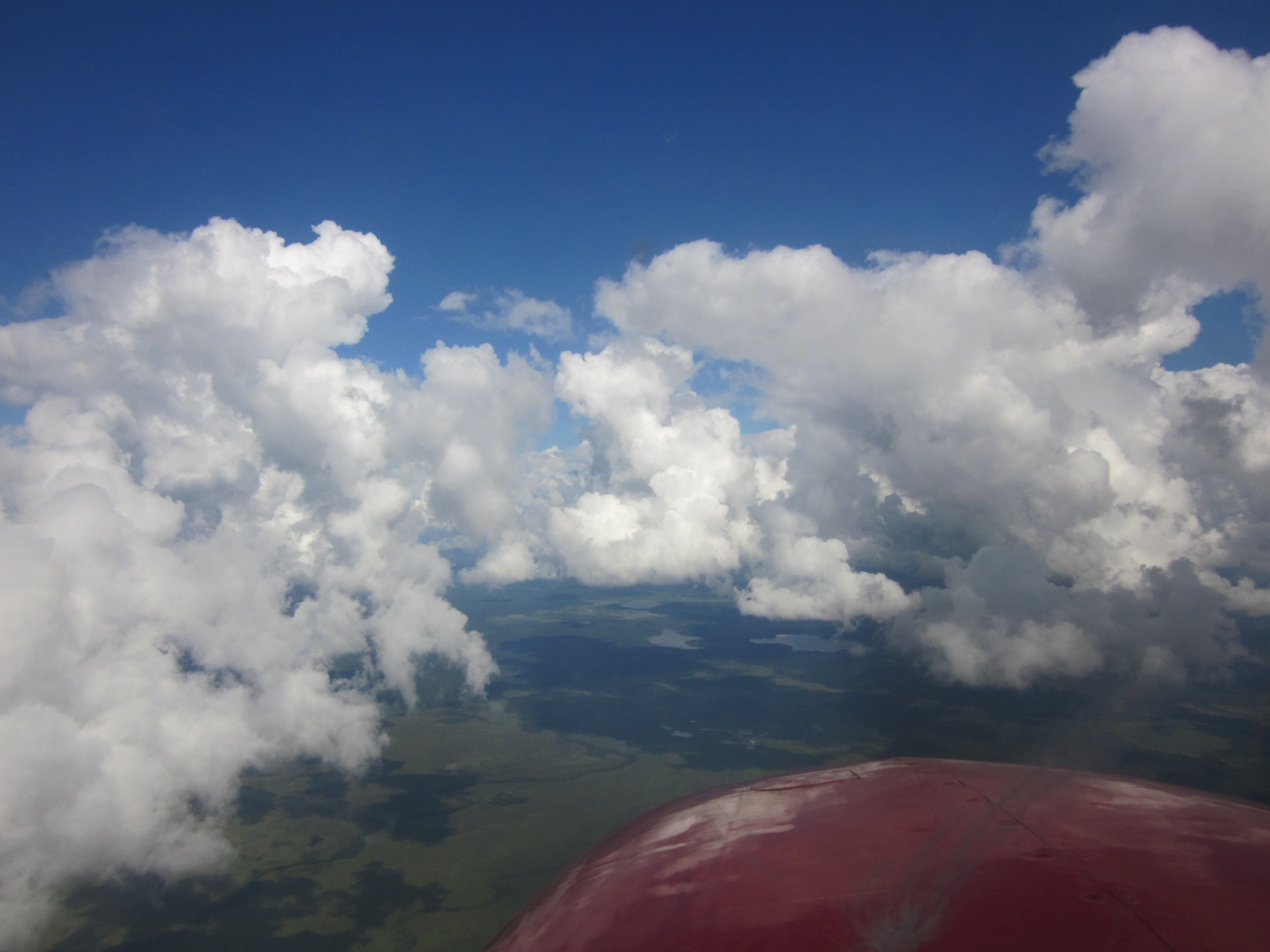
A sunny afternoon dodging clouds on the way back to Santa Cruz. They look like puffy white cotton balls in the sky.
Saturday, May 19, 2012
Doors Off

Some tourists from Europe called us up and wanted to do some video filming on the surrounding area. I flew an hour out from Santa Cruz to where they were staying, took off the cargo doors, and get the situated with a tripod all tied down and held securely in place.

This was their first time filming from an airplane like this, the Cessna 206 is nice for this kind of work as removing the cargo doors gives a wide area to shoot pictures from.

Good shot of the camera guys and the open doorway looking at the hills

Spectacular rock faces, always love seeing this and it was even more of a treat to look at it up close for filming!

San Fernando
A few weeks ago I got back from another trip to San Fernando. This is a small village of about 200 people where SAM has had a missionary working for the last 2 years. Recently a Bolivian couple decided that they would like to take over the work from the other missionary and I had the privileged of bringing them to San Fernando.

My usual accommodations are a tent with an airmattress set up on the church stage. Not the more comfortable, but its ok for one night at a time. Thankfully it was cooler than previous times when I have been there. 75 degrees instead of 90!

Jose Luis got me going in the morning with a breakfast of steak... not quite like IHOP but it works.


Nothing quite like flying on a beautiful morning. I was going to Robere to bring some supplies out to another village about 30 minutes away. The missionaries who live out there took 2 days to travel by road to Robere!

Robere, south eastern Bolivia. There is a highway and a rail road which connect this town to Santa Cruz.

Supplies and plastic chairs (a first for me to transport in the plane) going out to Santo Corazon in support of a children's after school program which the missionaries run. They had some of their food stolen recently and had to purchase more!
Tuesday, February 21, 2012
Camp!

In additions to flying and fixing airplanes, I have been helping out with the Junior and Senior High youth groups. All of the kids come from the school where most of the missionary children go and where SAM has a number of people on staff.

I was the counselor for the 8th grade boys and got to lead a couple of small groups in addition to evening devotions. Being a group of boys, my devotional on Ehud, the left-handed judge was well received.

The mosquitoes were feasting on us for days straight, but that did not detour us from playing board games or enjoying the fantastic view.

Friday, February 3, 2012
Electron Flow
In a couple weeks I will pass the 6 month mark of time spent in Bolivia. The process for getting a pilot license has been slow going, although the horse is smelling the barn and I expect to have a piece of plastic in hand withing the next week!

To get around the pilot license issue, I have flown with another pilot, Miguel. He used to be in the Bolivian Air Force and now flies for a living as an air taxi pilot. A few days ago he accompanied me on a flight to bring a single missionary lady out to her village where she works. On the way out, Miguel and I both noticed that the airplane batterywas no longer charging.

We quickly reduced the electrical loads and tried a few trouble shooting checks to no avail.
Even with a dead battery, the engine will continue to run because the ignition system self generates a spark. Not being able to get the flaps down would be a problem though as they reduce the landing distance and speed that is flown on approach. Thankfully it all worked out just fine and once one the ground we found the culprit. A broken ring terminal that connects to the alternator (the thing that generates electricity). Not having any ring terminals on hand, and being in the middle of the jungle meant it was time to improvise. Cutting back the insulation on the wire, we looped it around the terminal and tightened down the nut on top of the bare wire. We pronounced it good to go and on the flight home it performed flawlessly.

On the way home Miguel and I were talking and he mentioned that we were pretty "lucky" to have fixed the problem. I asked him if he believed in "luck" and that started a conversation about spiritual things where I was able to witness to him. Please pray for Miguel, that the seeds planted would take hold. It's called providence after all, not luck.

Subscribe to:
Posts (Atom)